

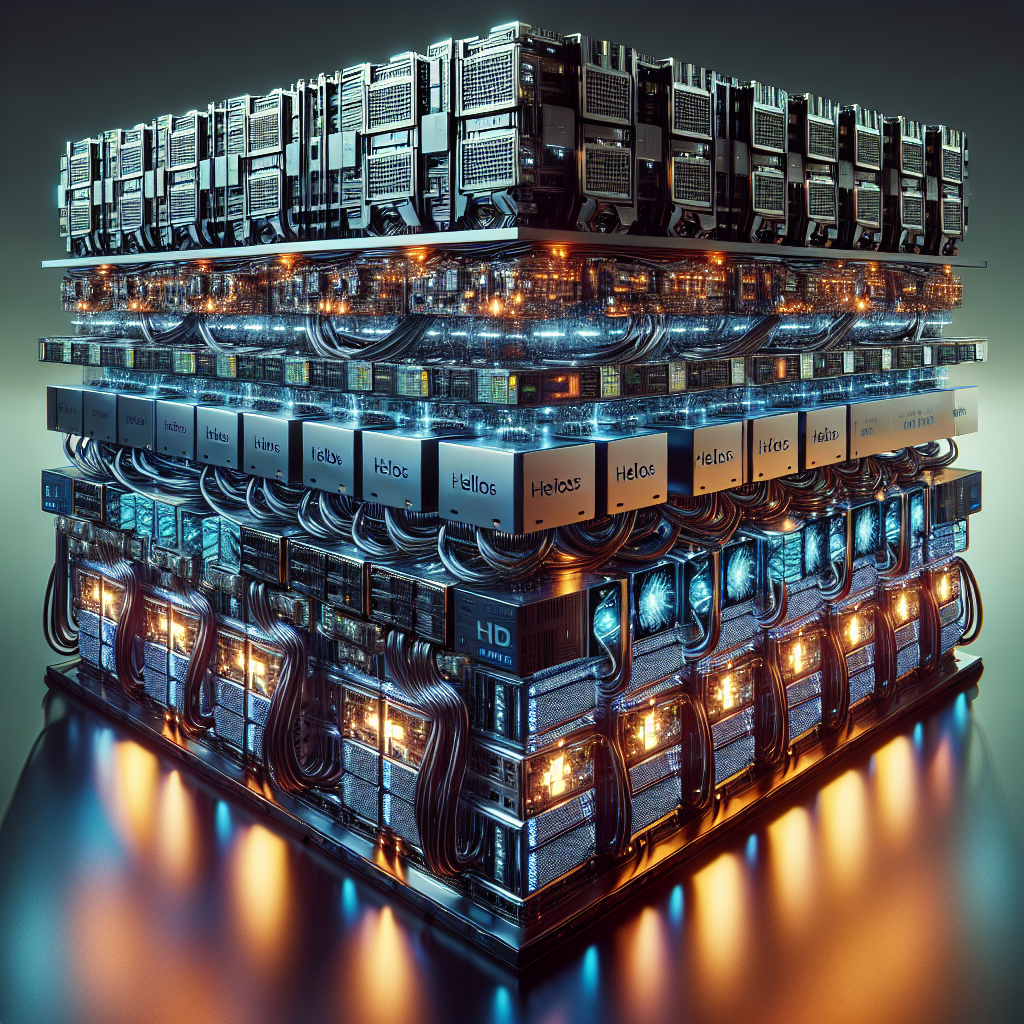
The landscape of artificial intelligence infrastructure is stirring with excitement as HPE, in collaboration with AMD, unveils its ambitious plans to deploy the cutting-edge Helios rack-scale AI architecture. Set to hit the market in 2026, this initiative is aimed at redefining the capabilities of AI workloads by integrating next-generation AMD Instinct accelerators with high-performing Venice CPUs, all delivered in an unparalleled GPU-dense environment.
At the heart of this ground-breaking design is the Helios architecture, which will feature full 72-GPU AI racks. These racks are designed to push the boundaries of performance, targeting an impressive 2.9 exaFLOPS of FP4 compute per rack. With a staggering 31TB of HBM4 memory, the Helios-based systems signify a major leap towards exascale AI performance, providing robust computational resources necessary for advanced AI applications and research.
A key element of Helios’ innovative design is its thermal management system, which leverages liquid cooling and a double-wide chassis to effectively handle the intense heat generated by such high-density configurations. This environmentally conscious approach not only enhances performance but also contributes to sustainability; waste heat from HPE’s GX5000 racks is planned to be utilized for heating campus buildings, showcasing a commitment to energy efficiency in high-performance computing.
One of the noteworthy aspects of the Helios architecture is its ability to integrate workloads across all GPUs seamlessly within a single pod structure. This capability alleviates local bottlenecks that can hinder processing efficiency, thereby enabling smooth execution of complex AI tasks. The system also features a purpose-built HPE Juniper switch that supports Ultra Accelerator Link over Ethernet, establishing a high-bandwidth interconnect for the GPUs, which stands in contrast to Nvidia’s NVLink-centric approach. This new method promises to facilitate scale-out designs that adhere to an open standards framework, making it a more versatile option for enterprises and research institutions.
The increasing performance of HPE’s AI solutions places it in direct competition with industry stalwart Nvidia, whose rack-scale platforms have long dominated the market. The integration of Meta’s Open Rack Wide standard into the Helios reference design reflects a trend toward more open and accessible hardware frameworks, breaking the mold of proprietary systems.
The future will reveal how effectively the Helios architecture performs under sustained multi-node workloads, as results of real-world applications remain untested at this stage. While theoretical comparisons suggest that these systems could match other high-end AI racks in terms of GPU counts, the reliance on a single Ethernet layer raises potential concerns about latency and bandwidth limitations that could affect real-world performance.
As the technology industry gears up for the global availability of Helios-based systems in the coming year, excitement builds among business leaders, product builders, and investors. This announcement underscores a pivotal moment in the AI race, revealing HPE’s strategic intent to expand its offerings and make high-performance AI hardware accessible to a wider array of users. Research institutions and enterprises alike stand to benefit from this enhanced access, propelling innovation and development in artificial intelligence applications.
As HPE and AMD prepare for the rollout of this ambitious architecture, all eyes will be on how effectively Helios can meet its performance targets and carve out a significant presence in the competitive landscape of AI infrastructure. The evolution of technologies like Helios not only signals advancements in computing power but also paints a picture of a future where AI integration into various sectors becomes increasingly practical and efficient.
Leave a Reply