

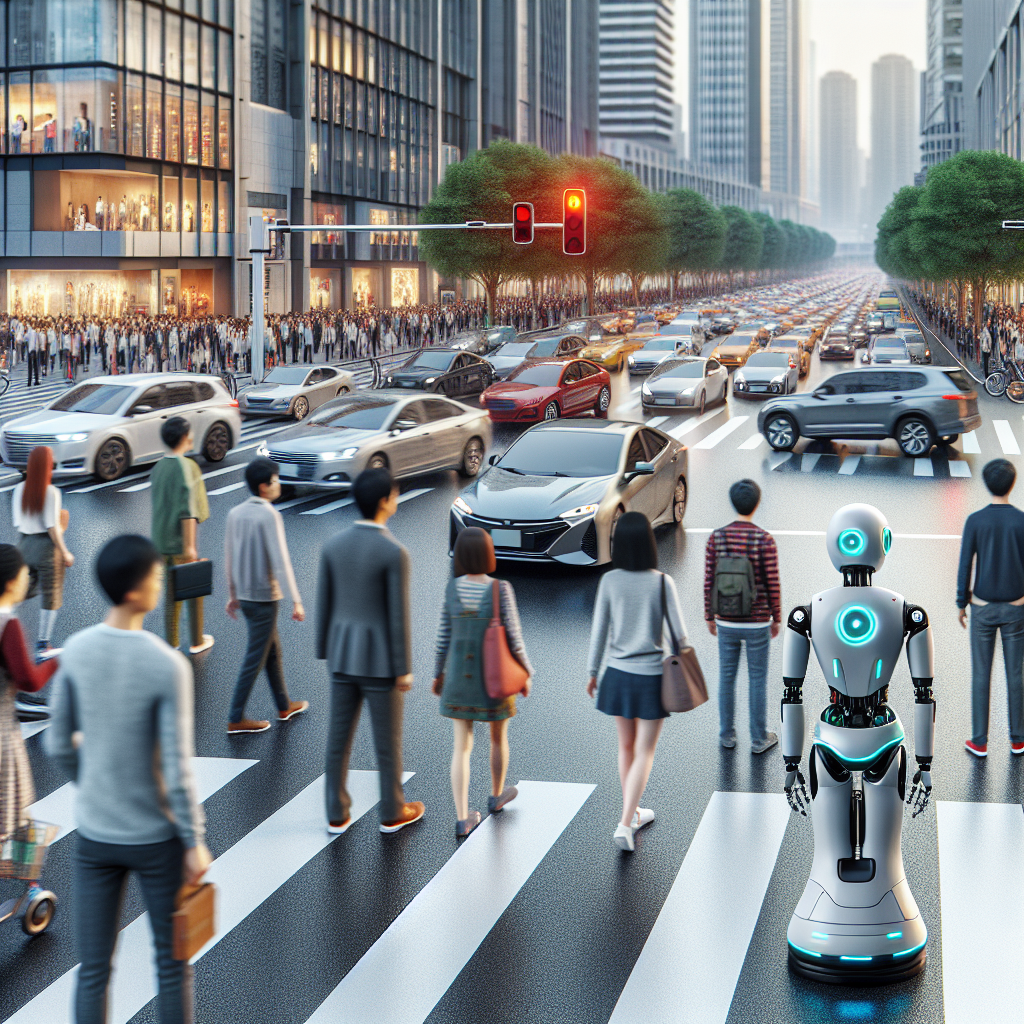
In a remarkable leap forward in urban management and safety, Hangzhou, a bustling city in China, has introduced a groundbreaking innovation in traffic control: the Hangxing No. 1, an AI-powered humanoid robot police officer. This ambitious endeavor seeks to redefine how traffic is managed at busy intersections by employing advanced robotics to aid human officers in enforcing traffic laws and ensuring pedestrian safety.
The Hangxing No. 1 stands at an impressive 1.8 meters (5 feet 11 inches) tall and operates primarily at the crowded intersection of Binsheng Road and Changhe Road in the Binjiang District. With its high-definition cameras and sensors, this humanoid traffic officer is capable of directing vehicles and pedestrians, spotting violations, and issuing polite verbal warnings to offenders. A unique feature of Hangxing No. 1 is its integration with the existing traffic signal system, allowing it to respond promptly to changes in traffic lights, further streamlining the flow of vehicles and maintaining order at one of the city’s busiest junctions.
The introduction of Hangxing No. 1 is part of a pilot program launched by the Hangzhou Traffic Police Tactical Unit at the beginning of December. While its current role is to assist human officers rather than replace them, authorities have ambitious plans to enhance its capabilities. Future upgrades will potentially include large language model (LLM) technology, enabling the robot to give more detailed directions and engage in more meaningful interactions with pedestrians and drivers alike.
One can imagine a scene where, instead of merely gesturing “stop” and “go” with its arms, the Hangxing No. 1 could guide a lost tourist or alert motorists to unexpected road closures through a conversation. The enhancements envisioned for this robot underscore the potential for AI-driven technologies to enrich daily human experiences and improve decision-making on the roads.
Another notable aspect of Hangxing No. 1 is its ability to identify specific traffic violations, such as unhelmeted cyclists and jaywalkers. This autonomous enforcement capability aims to encourage compliance with traffic rules, thereby increasing safety not only for motorists but also for vulnerable pedestrians. The robot’s movement is facilitated by omnidirectional wheels, enhancing its navigational capabilities within the intersection, ensuring that it can respond to real-time traffic conditions dynamically.
Hangxing No. 1 isn’t alone in its role as a robotic police officer within China. Other cities have also experimented with similar technologies, indicating a growing trend. For instance, Shenzhen has deployed EngineAI’s PM01 model, and Wenzhou has seen the introduction of Logan Technology’s spherical RT-G bot. Additionally, Chengdu welcomed its own humanoid traffic cop in June, showcasing a collective interest in integrating AI into public safety and urban management.
This trend speaks volumes about China’s commitment to leveraging AI technology not just for consumer applications but also for enhancing public infrastructure. The evolution of traffic control robots is reflective of a larger narrative in the tech world—one where smart cities utilize AI to create safer, more efficient urban environments.
Comparatively, the Hangxing No. 1 represents a significant advancement over earlier models, such as the AnBot, which had a rather unflattering design reminiscent of a cross between a Dalek and a refrigerator. When the AnBot was deployed in September 2016, it was considered innovative. However, technological advancements in robotics and AI have progressed so rapidly that what was once cutting-edge is quickly rendered obsolete. The trajectory of innovation suggests that within the next few years, newer and more capable models may emerge, pushing the boundaries of what robotic assistants can achieve.
In conclusion, the emergence of AI-powered humanoid robots like Hangxing No. 1 represents a noteworthy development in the intersection of technology and public safety. As these systems evolve, they hold the promise of transforming traffic management and urban experiences, reinforcing China’s position as a leading innovator in the field of robotics and artificial intelligence. The future of smart cities looks bright as we continue to embrace such advancements in the realm of AI.
Leave a Reply