

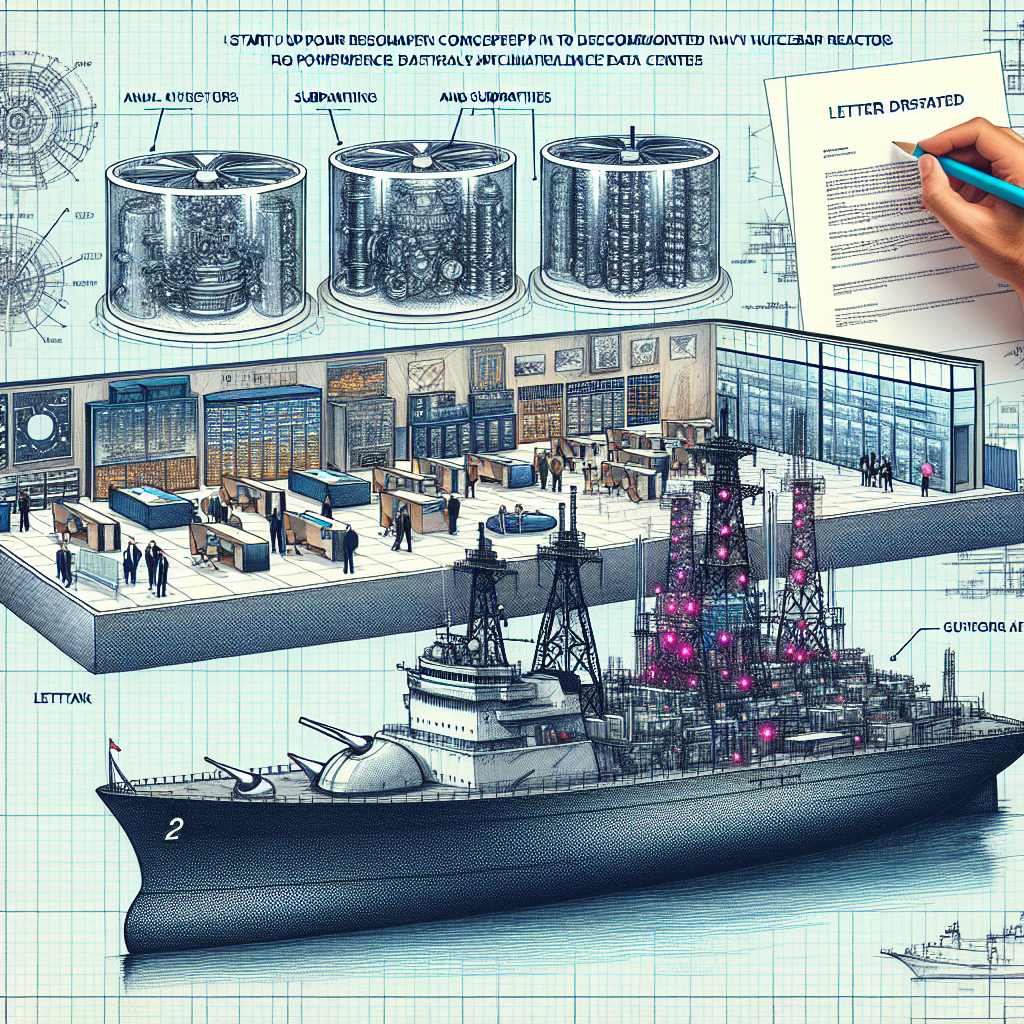
A groundbreaking proposal has emerged from HGP Intelligent Energy, a Texas-based startup aiming to harness the power of retired U.S. Navy nuclear reactors to fuel AI data centers. The firm has submitted a request to the U.S. Department of Energy (DOE) with plans to repurpose two retired nuclear reactors, potentially shifting the dynamics of energy production and data management in the technology sector.
The ambitious project is set to take place at Oak Ridge National Laboratory in Tennessee, under President Donald Trump’s Genesis Mission. HGP Intelligent Energy seeks to utilize the power from two aging reactors to deliver a robust output of 450 to 520 megawatts. While the exact sources of the reactors have not been specified, industry insiders speculate that they may come from the legacy of the U.S. Navy’s extensive fleet.
Currently, the U.S. Navy employs the Westinghouse A4W reactors in its Nimitz-class nuclear aircraft carriers and the General Electric S8G reactors in its Los Angeles-class nuclear-powered submarines. Notably, the USS Nimitz, which was commissioned in 1975, is nearing the end of its operational life, alongside a significant number of Los Angeles-class submarines that have also been decommissioned since their introduction in the late ’70s.
The World Nuclear Association highlights the safety records of these naval reactors, asserting that over 100 have been operated by the Navy for more than five decades without any radiological incidents. This impressive reliability lays the groundwork for the proposed civilian repurposing, which would mark a historical first in the use of military reactors for civilian applications.
The estimated costs for activating these reactors for civilian use range between $1 million to $4 million per megawatt. While these figures may initially appear daunting, they represent a fraction of the cost associated with constructing an entirely new nuclear power facility or the emerging small modular reactors being explored by major tech corporations such as Amazon, Meta, Oracle, and Google.
By opting to refurbish retired reactors, HGP Intelligent Energy capitalizes on a sustainable approach that not only saves financial resources but also promotes an environmentally conscious solution by extending the lifecycle of existing nuclear assets. This concept not only reflects an innovative use of technology but illustrates prudent resource management in energy production amidst mounting global energy demands.
The complete project is projected to cost between $1.8 billion and $2.1 billion, covering the requisite infrastructure overhaul needed to prepare and convert these nuclear reactors for integration into modern data centers. Once operational, the company anticipates establishing a revenue-sharing agreement with the government, which would foster a synergistic relationship aimed at maximizing the project’s utility for both parties. Additionally, HGP plans to create a decommissioning fund to address the financial burdens associated with handling retired nuclear materials.
The dismantling of a typical nuclear asset is an expensive endeavor, as was noted with the decommissioning of the U.S.’s first nuclear-powered aircraft carrier, which incurred costs that far exceeded that of its last conventionally powered counterpart.
Gregory Forero, the CEO of HGP Intelligent Energy, expressed confidence in his company’s capacity to manage this operation effectively and safely at scale. “We already know how to do this safely and at scale,” says Forero. “And we’re fortunate to have a solid base of investors and partners who share that vision.”
This venture is not just about energy production; it also symbolizes a potential shift in how retired military technology could be harnessed for civilian innovation. If successful, this initiative could pave the way for additional projects leveraging surplus military assets for modern applications, ultimately integrating advanced technological infrastructure into our everyday lives.
In a landscape dominated by concerns over energy sustainability and environmental impact, HGP Intelligent Energy’s proposal might just be the pioneering solution that merges advanced nuclear technology with the rising demands of AI and big data processing. By engaging with the DOE for support, this startup is not only proposing a viable path forward for energy sourcing but also enriching the dialogue around the future of nuclear technology in civilian industries.
Leave a Reply