

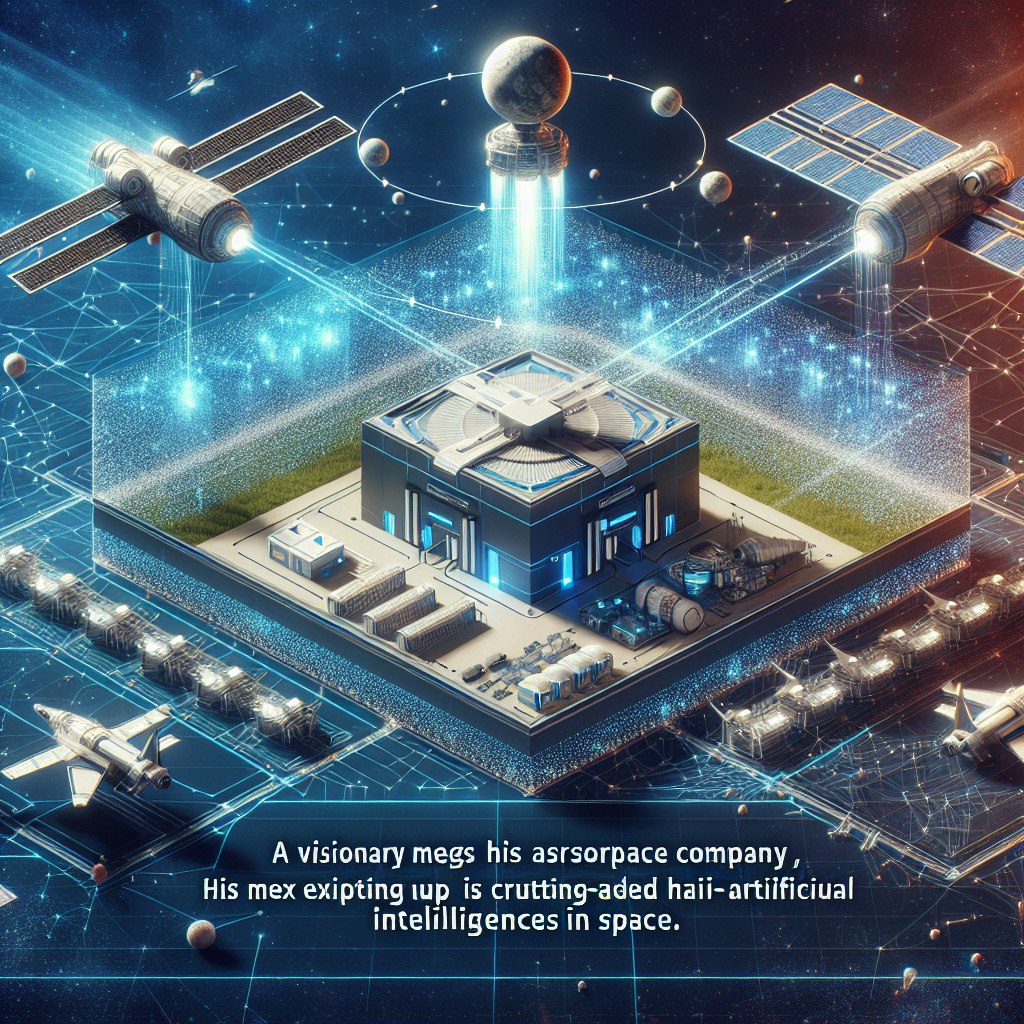
Elon Musk has unveiled an ambitious vision that merges two of his powerhouse companies—SpaceX and xAI. This merger is not just a typical corporate acquisition; it signifies Musk’s strategic movement towards addressing one of the most pressing challenges of modern artificial intelligence (AI): its exponential energy demand. In a recent announcement made on the SpaceX website, Musk described his plan to construct solar-powered, space-based data centres that could support AI’s burgeoning needs.
Musk emphasizes that the increasing demand for AI will necessitate “immense amounts of power and cooling”—resources that cannot be sustainably provided on Earth without causing significant hardship and environmental impact. This raise a compelling question for business leaders and investors: as AI continues to evolve, how do we balance technological growth with environmental sustainability? According to Musk, the answer lies beyond Earth’s atmosphere. He states, “the only logical solution therefore is to transport these resource-intensive efforts to a location with vast power and space.” By harnessing solar energy in space, Musk believes we can meet these demands without compromising our planet.
The merger of SpaceX and xAI will converge Musk’s initiatives in areas like space exploration, AI development, social media, and internet services. While SpaceX is renowned for its Falcon and Starship rocket programs, xAI is gaining recognition for its cutting-edge AI technologies, including the Grok chatbot. This union promises to streamline projects and enhance innovation within the two firms. Moreover, with both companies holding significant contracts with U.S. government agencies such as NASA and the Department of Defense, the impact of this merger could extend well beyond commercial interests.
Interestingly, Musk is not alone in recognizing the potential of space-based data centres as a solution to AI’s energy challenges. Competitors in tech, such as Jeff Bezos’s Blue Origin and Google’s Project Suncatcher, are also exploring solar-powered data centres positioned in space. Yet, Musk argues that no vehicle to date has had the capability to launch the necessary megatons required for these ambitious infrastructures. Highlighting the unique challenges presented in space, Musk notes, “In the history of spaceflight, there has never been a vehicle capable of launching the megatons of mass that space-based data centres or permanent bases on the Moon and cities on Mars require.”
The potential for growth in this sector is immense. Musk has plans that stretch well into the future, including the ambitious goal of launching a million satellites. The development of SpaceX’s Starship rocket aims to enable up to one launch per hour with a payload capacity of 200 tonnes. This impressive capability not only supports the strategic vision of executing major projects like the data centres but also underscores the rapid evolution of satellite technology and its contribution to AI infrastructure.
Furthermore, SpaceX’s Starlink, a subsidiary providing satellite-based internet service, is also set to receive a significant upgrade through this merger. Musk’s statement mentions the arrival of next-generation satellites, which promise to enhance the capacity of Starlink’s constellation more than twentyfold compared to previous versions.
For business leaders, investors, and product builders, the implications of this merger are profound. As AI technology continues to integrate into various sectors, understanding the energy and infrastructural demands it imposes becomes increasingly crucial. The collaboration of SpaceX and xAI heralds a future where AI could thrive in an environment designed specifically to accommodate its needs—on a scale previously thought impossible.
The enthusiasm surrounding this merger is further highlighted by Musk’s ambitious timelines, estimating that in the next two to three years, the lowest-cost method to generate AI compute power will be in space. As this plan unfolds, staying informed and engaged with advancements in both AI technology and space exploration will be essential for any stakeholder navigating this fast-evolving landscape.
Leave a Reply