

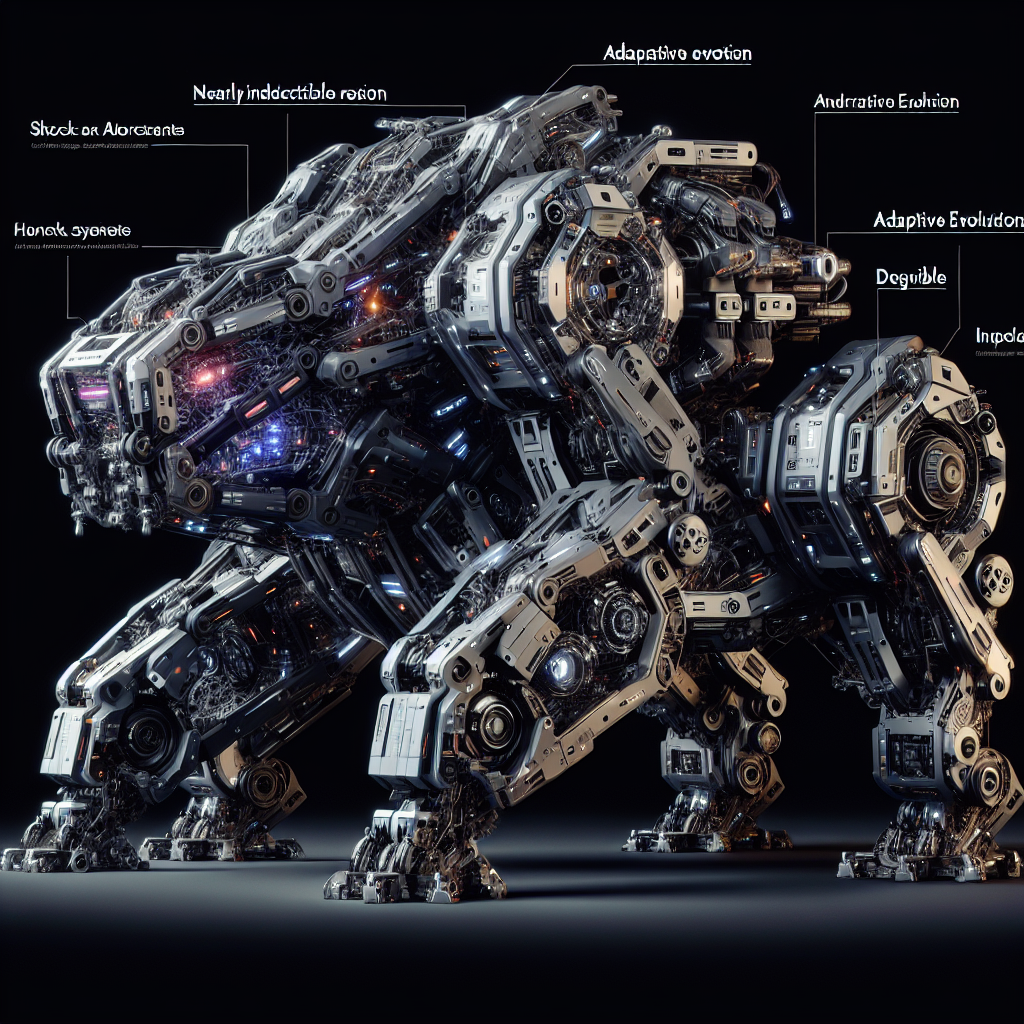
In a revolutionary leap forward, researchers at Northwestern University have harnessed the power of artificial intelligence to design a fundamentally new type of robot—the legged metamachine. This groundbreaking creation challenges the conventional understanding of robotics, ushering in an era of machines that are not only agile and adaptable but also nearly indestructible.
Traditionally, robots are crafted for specific environments and conditions. A warehouse robot is engineered to glide across smooth concrete, while robotic dogs excel at navigating stairs. However, this specialization often comes at a cost; these machines lack the versatility to tackle unpredictable challenges. For instance, a robot that performs splendidly on firm ground may fail dramatically when faced with mud or other hazards. The Northwestern researchers, however, have approached this issue from a different perspective.
The team has focused on creating robots that can dynamically reconfigure themselves in response to changing situations, breaking free from the limitations of static design. The product of this innovative thinking is the legged metamachine, a modular robot that can adapt its form and function according to the terrain it encounters.
Visually striking and somewhat unusual in its movement, the legged metamachine is constructed from multiple Lego-like modules. Each of these units functions autonomously, featuring essential components such as a battery, motor, and computer. The design itself is deceptively simple, combining a central ball with adjoining arms or legs capable of rotating along a single axis. This modularity not only allows for collaborative movement but also contributes to the robot’s remarkable resilience.
Each individual module can perform a variety of actions; it can roll, twist, or even jump independently. When assembled, these modules communicate through their internal computers, enabling a wide range of movements—jumping, crawling, rolling, and undulating. The coordination among the modules creates a form of movement that is both chaotic and effective. Essentially, the legged metamachine adapts its behavior based on the challenges it faces, making it a remarkable blend of intelligence and physical capability.
The most impressive aspect of this design is its inherent indestructibility. If a module gets damaged or detaches from the ensemble, the remaining modules can continue performing their intended tasks without missing a beat. This self-sufficient nature sets a new benchmark for robotic reliability, challenging traditional notions about the fragility of machines.
Perhaps the most fascinating component of this research is the role of artificial intelligence in the robot’s design. Researchers have traditionally played the primary role in developing robotic structures, often mimicking natural locomotions or established technologies. However, with this new method, AI takes the forefront, evolving solutions in ways that may not have been previously contemplated. By allowing AI to guide the evolutionary process of the design, the team has opened new avenues for robotic capabilities that may extend beyond our current understanding.
The implications of this research are profound and span multiple sectors. In environments where adaptability and resilience are crucial—such as disaster recovery, agriculture, or search and rescue operations—these AI-evolved robots could dramatically enhance operational efficiency and effectiveness. The potential for these machines to navigate complex terrains and recover from damage could redefine the standards for robotic applications.
Moreover, this innovative approach suggests that the future of robot development might heavily rely on AI-driven processes, fundamentally altering how engineers and designers view machine evolution. This paradigm shift could foster more resilient and versatile machines, tailored to address challenges that haven’t even emerged yet.
As the Northwestern researchers continue their work on the legged metamachine, the world watches with baited breath for what comes next in the intersection of artificial intelligence and robotics. The future holds promise not just for these adaptable robots, but for the vast possibilities they represent in reshaping industry, enhancing our daily lives, and perhaps even changing our understanding of intelligence itself.
Leave a Reply