

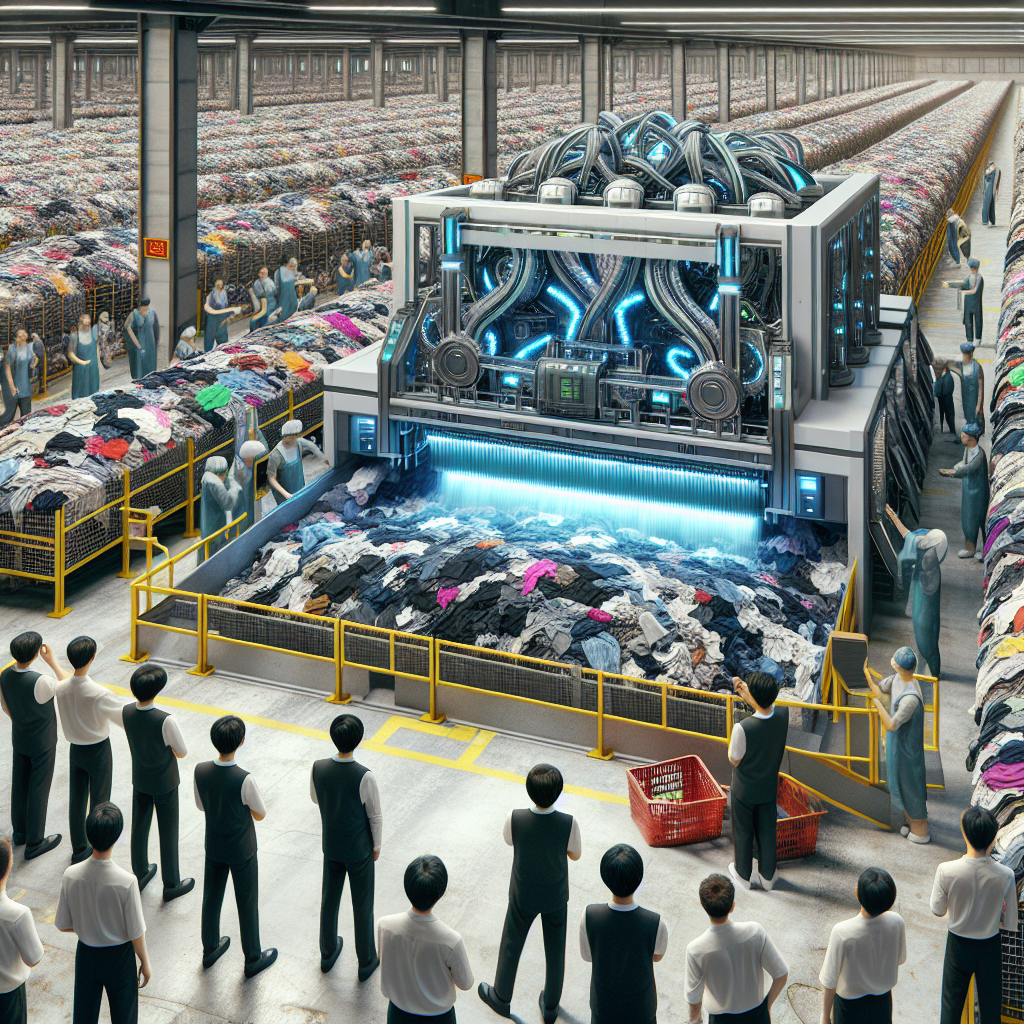
In a significant breakthrough for recycling technology, a company in eastern China has introduced an innovative AI-powered machine that sorts discarded clothing with remarkable speed and efficiency. Located in Zhangjiagang, a city in Jiangsu province, this cutting-edge machine, known as Fastsort-Textile, offers a glimpse into the future of textile recycling and the role artificial intelligence can play in addressing the pressing issue of synthetic textile waste.
Developed by DataBeyond, an artificial intelligence recycling company founded in 2018, Fastsort-Textile was recognized as one of Time magazine’s Best Inventions of 2025. The machine’s unique ability to analyze the composition of textiles enables it to sort materials much faster than human workers, revolutionizing the way textile waste is processed.
The textile industry has long been a significant contributor to environmental pollution, with synthetic textiles made from fossil fuels accounting for roughly 70% of global production. Given this context, the Fastsort-Textile machine aims to reduce the volume of textile waste that ends up incinerated, thus promoting recycling and resource efficiency. Mo Zhuoya, the CEO of DataBeyond, emphasizes the importance of this technology in making full use of textile waste and mitigating its harmful environmental effects.
The current use of the Fastsort-Textile machine is exclusive to Shanhesheng Environmental Technology Ltd., a textile recycling facility in Zhangjiagang that installed the machine in 2025. This facility has rapidly turned into a hub for innovative recycling practices, setting a standard for others to follow. By employing the Fastsort-Textile machine, the facility has been able to enhance productivity significantly.
Statistics reveal the efficiency of this machine. Fastsort-Textile processes an impressive 100 kilograms (220 pounds) of clothing in just two to three minutes—an accomplishment that would typically take a human worker around four hours. Furthermore, the machine boasts a processing capacity of two tons per hour, whereas a team of two workers would require nearly two days for the same amount, highlighting both the speed and accuracy of the AI-driven technology.
The operational mechanics of the Fastsort-Textile involve an AI scanner that scans and analyzes the fabric composition, which is supported by a network of conveyor belts. Textile stacks are loaded onto these belts, allowing them to pass through the scanner that sorts the fibers automatically. This smart process not only boosts productivity but also enhances the accuracy of sorting, enabling higher quality recycling outcomes.
The implications of this technology extend beyond mere efficiency; it symbolizes a crucial step towards sustainable practices in the fast-fashion industry. As China leads the globe in textile exports—reaching a staggering $142 billion, which is more than double that of the European Union—the adoption of such recycling technologies becomes essential in combating pollution associated with clothing production and disposal.
Despite the evident advantages offered by the Fastsort-Textile machine, challenges remain in scaling such solutions across the textile recycling industry. Currently, only one facility in China employs this technology, and broader adoption will require investment and partnership across sectors to facilitate the infrastructure necessary for widespread use. As demand for sustainable practices increases, the potential for this or similar technologies to become prevalent is promising.
As companies and investors begin to recognize the importance of sustainable practices, the Fastsort-Textile machine stands as an example of how innovation can foster change in traditional industries. It showcases the capability of artificial intelligence to address complex environmental issues while providing tangible benefits for business leaders looking to invest in responsible, future-oriented technologies.
Leave a Reply