

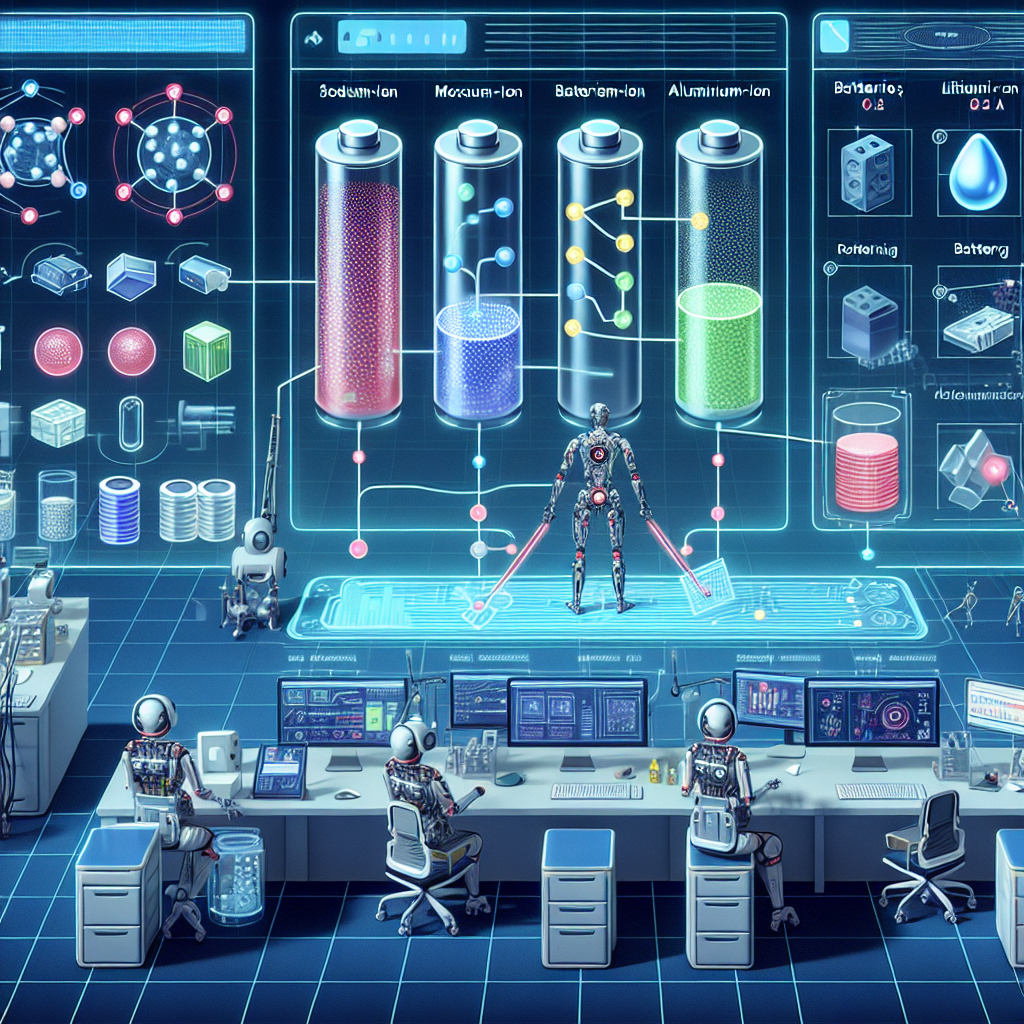
As the global demand for energy storage continues to rise, finding innovative and sustainable battery alternatives to lithium-ion technology has become critical. Researchers from the New Jersey Institute of Technology (NJIT) have made significant strides by harnessing artificial intelligence (AI) to discover promising new materials for energy storage solutions.
In their groundbreaking research published in Cell Reports Physical Science, the NJIT team, led by Professor Dibakar Datta, addressed the pressing need for affordable and sustainable alternatives to traditional lithium-ion batteries. These batteries have long been the standard in energy storage but face challenges related to supply shortages and environmental concerns.
The key to the NJIT team’s success lies in the exploration of multivalent-ion batteries, which utilize elements such as magnesium, calcium, aluminum, and zinc—elements that are abundant and more sustainable than lithium. Unlike lithium ions, which carry a single positive charge, multivalent ions possess two or even three positive charges, allowing these new battery types to store significantly more energy, thus enhancing their potential for various applications.
However, the primary challenge with multivalent-ion batteries has been the difficulty in efficiently accommodating these larger and more charged ions within the battery’s materials. Traditional methods of testing millions of potential material combinations proved to be slow and inefficient. Datta highlighted the difficulty in identifying the right materials: “One of the biggest hurdles wasn’t a lack of promising battery chemistries—it was the sheer impossibility of testing millions of material combinations.”
To overcome this barrier, the NJIT team deployed a dual-AI strategy involving a Crystal Diffusion Variational Autoencoder (CDVAE) alongside a finely tuned Large Language Model (LLM). This innovative approach allowed researchers to rapidly analyze thousands of crystal structures to identify viable candidates, a feat that would have taken an impractical amount of time using traditional experimental techniques.
The CDVAE model was meticulously trained on extensive datasets containing known crystal structures, which enabled it to propose entirely novel materials with versatile structural configurations. The LLM, on the other hand, was specifically refined to focus on materials that exhibit thermodynamic stability—an essential characteristic that ensures practical synthesis in laboratory settings.
According to Datta, the integration of these AI tools has significantly accelerated the discovery process, leading to the identification of five new porous transition metal oxide structures that show exceptional promise for use in multivalent-ion batteries. This advancement not only paves the way for more efficient energy storage solutions but also contributes to a more sustainable future.
The potential implications of this research are vast. As energy demands grow globally, the shift towards sustainable energy storage technologies will be critical in addressing future energy challenges. The findings from NJIT could inspire new directions in battery technology that align with global sustainability goals, reducing reliance on lithium and minimizing environmental impacts.
Furthermore, as the research community increasingly turns to AI-driven methodologies, it underscores a transformative moment in material science. The ability to harness AI for rapid material discovery is reshaping how researchers approach longstanding challenges, heralding a new era of innovation in energy solutions.
While this research represents a significant leap towards the goal of sustainable energy storage, further studies and real-world testing will be essential to validate these findings and ensure the readiness of these new materials for commercial applications. The future of energy storage thus lies not only in advancing technologies but also in fostering new methodologies that enhance our ability to innovate at speed, ensuring our energy systems are both efficient and sustainable.
Leave a Reply