

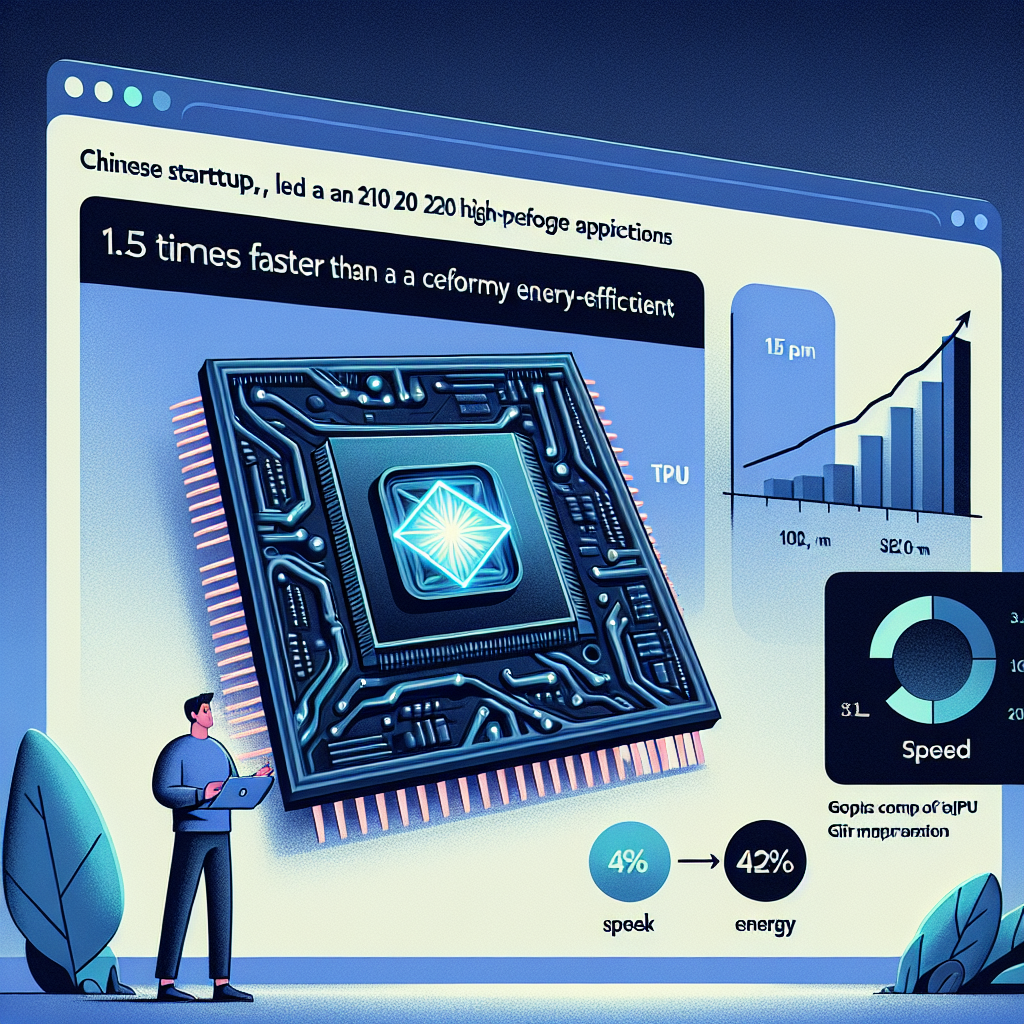
The rapid advancement of AI technology hinges significantly on the availability of powerful and efficient hardware. In a noteworthy development, the Chinese startup Zhonghao Xinying has introduced a General Purpose Tensor Processing Unit (GPTPU) that potentially stands as a formidable alternative to established international hardware like Nvidia’s A100 graphics cards and Google’s TPUs. The company claims that its custom ASIC chip, referred to as the ‘Ghana’ chip, is up to 1.5 times faster than Nvidia’s A100, which launched back in 2020, all while being 42% more efficient.
This advancement is significant, especially considering the backdrop of China’s growing ambition to achieve greater silicon independence amidst increasing global competition in the semiconductor sector. While the Ghana chip technology is still a few generations behind the latest offerings from Nvidia and others, it symbolizes a crucial step toward enhancing domestic capabilities in AI and machine learning applications. The emergence of home-grown chips can empower local developers, reduce reliance on foreign technology, and elevate China’s standing in the global tech landscape.
The Ghana chip comes from a well-qualified team led by Yanggong Yifan, a former Google engineer with substantial expertise in chip architecture, having previously contributed to multiple iterations of Google’s own Tensor Processing Units. Co-founder Zheng Hanxun adds to the team’s depth with experience from Oracle and Samsung’s R&D facility, further bolstering the startup’s credibility in creating competitive technology.
One of the notable features of the Ghana chip is its design, which is said to utilize only self-controlled intellectual property for its core architecture. This unique approach means the startup claims there is no dependency on foreign licenses or technologies, potentially offering a secure and sustainable route for chip development. In an era where national security and access to technology are increasingly linked, this independence from western companies could serve as a significant advantage for Zonghao Xinying and the broader Chinese tech industry.
Moreover, Zhonghao Xinying asserts that the Ghana chip’s manufacturing process is an order of magnitude more efficient than that used by leading overseas GPU manufacturers, allowing it to consume only around 75% of the power compared to equivalents in the market. If validated, this could not only represent a breakthrough in chip design but also promote energy efficiency in AI computations—a pressing concern for sustainability in technology.
However, while the company’s claims about performance gains are promising, the Ghana chip will have to overcome several hurdles to establish itself firmly in the market. The Nvidia A100, though several years old, was cutting-edge technology during its release and has been succeeded by the advanced architectures of Hopper and the latest Blackwell Ultra chips, which undoubtedly push the boundaries of AI computing power even further. Therefore, it’s critical for Zhonghao Xinying to substantiate its performance claims through rigorous testing and real-world applications.
This development emerges in a pivotal moment for the AI chip sector, which has seen a surge in demand and investment driven by a worldwide boom in AI applications. As companies look to harness the power of machine learning and data processing, alternative chip technologies that offer competitive performance at lower costs and improved efficiency will find a receptive market. Notably, if Zhonghao Xinying can successfully position the Ghana chip as a viable option, it could redefine market dynamics, urging industry giants to respond to this emerging competition.
In conclusion, the Ghana chip represents a significant initiative from a Chinese startup carved out of expertise in global tech companies. Its potential to deliver enhanced performance and efficiency amidst China’s strategic goals for semiconductor self-sufficiency aligns perfectly with a growing trend of increased localization of technology across various sectors. As the landscape continues to evolve, stakeholders in the tech and business realms will do well to observe how Zhonghao Xinying and its Ghana chip progress in the coming months.
Leave a Reply