

The race to achieve artificial general intelligence (AGI) has instigated a relentless push in the tech sector, prompting significant investments in building data centers. This development is advancing at a rate that far exceeds the capacity of manufacturers to deliver essential components. Not only are hard disk drives (HDDs) affected, but the ongoing DRAM shortage has exacerbated the situation, with memory kits seeing their prices soar to more than double compared to just a few months ago.
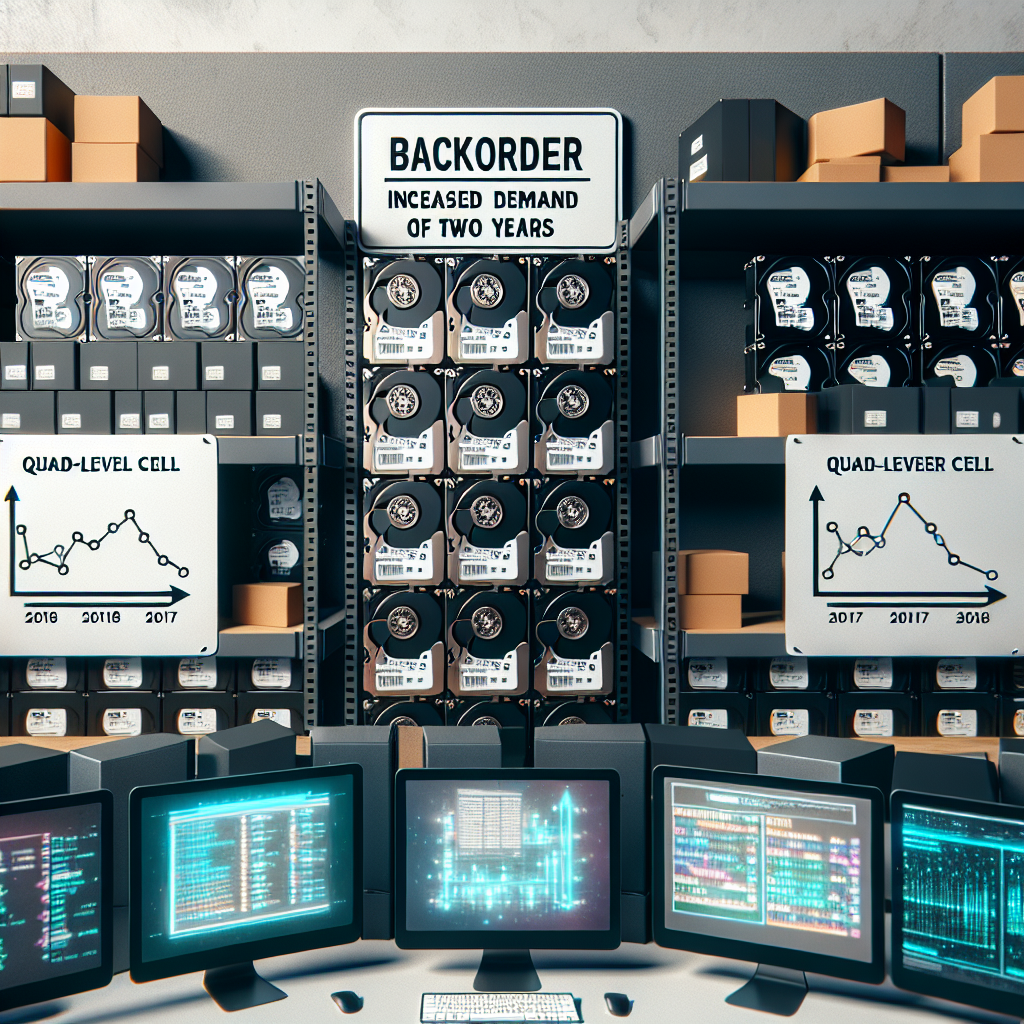
According to recent reports by DigiTimes, delivery times for enterprise-grade HDDs have now escalated to a staggering two-year backlog. This situation presents a formidable challenge for firms in need of large-capacity hard drives, which are crucial for nearline storage solutions. With AI funding driving the market, hyperscalers—large-scale cloud service providers—are being forced to pivot rapidly, opting for QLC NAND-based solid-state drives (SSDs) to circumvent these extensive backorders.
The transition from traditional HDDs to QLC SSDs—which utilize quad-level cell technology—allows these companies to manage costs while still ensuring sufficient data storage endurance suitable for cold storage needs. However, this shift is not without its complications. As cloud providers rush to acquire QLC NAND, a new shortage may emerge, consequently driving up prices. The indirect ripple effects of this demand increase might soon manifest as a rise in SSD prices globally, particularly since most value-oriented storage models lean towards QLC to conserve costs.
DigiTimes highlights a concerning forecast: production capacity for QLC is fully booked through 2026 at several NAND manufacturers. This indicates that firms aiming for expansion in AI capabilities are scooping up available supplies, further complicating the supply landscape. Notably, the popularity of QLC NAND may well surpass that of triple-level cell (TLC) technology by early 2027, signaling a pivotal change in the data storage environment.
Recent reports have revealed that major manufacturers, including Sandisk, have already increased NAND prices by 50%—a sharp rise that follows an earlier announcement of a 10% increase only two months prior. These sudden price hikes have left many in the industry reeling, while other companies have registered extraordinary profit margins, a stark deviation from past years’ challenges.
Looking at the broader picture, the unexpected scarcity of memory and storage resources can largely be attributed to AI ambitions unleashed by the wealthiest tech giants. This urgency and unpredictability have serendipitously brought forth unforeseen consequences in supply chains. In the span of a few short weeks, industry insiders and analysts are coming to grips with the pressing reality that manufacturers previously equipped with buffer capacities of 2-3 months are now struggling with reduced availability, often limited to just a few weeks.
As tech companies grapple with these shifts, the consumer market is feeling the effects of the electronics scarcity yet again. The rapid transition to QLC SSDs is a necessary adaptation; however, it raises questions about the sustainability of supply and pricing trends going forward. As firms navigate uncharted territories within this evolving landscape, the need for innovative solutions in both product design and manufacturing processes has never been more critical. This need goes hand-in-hand with considerations toward long-term strategies to balance consumer demand without further aggravating scarcities.
In conclusion, the dual crises of HDD backorders and DRAM shortages are pushing enterprises toward an evolution in data storage technology that could reshape market dynamics. Companies that strategically navigate this challenging landscape may emerge with enhanced capabilities, while those that fail to adapt may find themselves stranded in a turbulent market.
Leave a Reply