

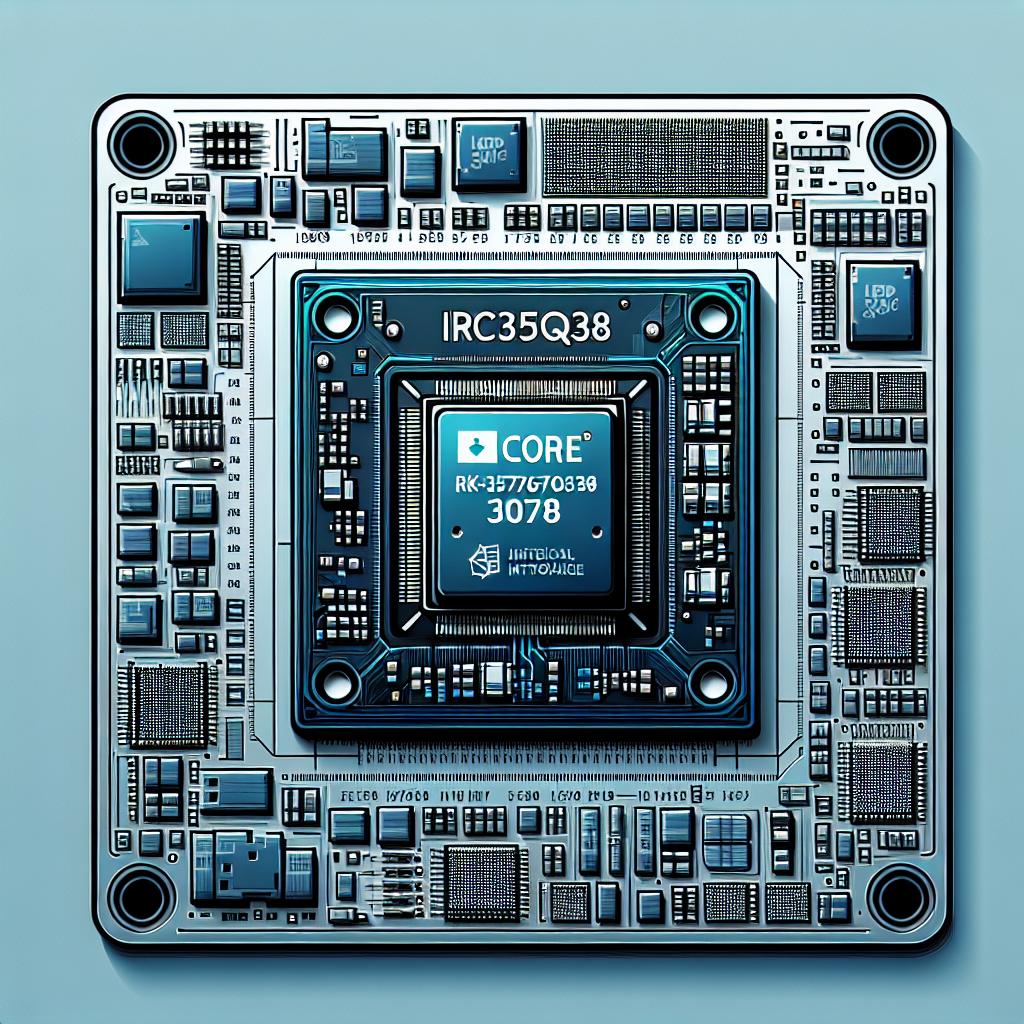
The ICORE-3576Q38 stands as an impressive innovation in the realm of embedded systems, combining compact size with powerful processing capabilities. Developed by T-Firefly, this system-on-module (SoM) is designed for applications where space constraints are critical while still delivering robust multi-core performance and local artificial intelligence (AI) acceleration.
This module measures just 38 mm × 38 mm, making it a practical solution for embedded and industrial designs. It utilizes the Rockchip RK3576 application processor, specifically tailored for environments demanding high-performance computation in a small footprint. The compact design does not compromise its capabilities; it offers a significant degree of multimedia and I/O support.
The ICORE-3576Q38 family is comprised of three distinct variants: the standard ICORE-3576Q38 for general commercial use and two industrial versions, the ICORE-3576JQ38 and ICORE-3576MQ38. While all models share a unified architecture, their specifications diverge slightly, offering different CPU frequencies and operational temperature ranges to suit various application needs.
The standard model excels with CPU frequencies reaching up to 2.2 GHz, achieved through a quad Cortex-A72 and quad Cortex-A53 configuration. In contrast, the industrial variants are limited to a maximum frequency of 1.6 GHz, which ensures stability and reliable performance across broader temperature ranges—an essential feature for machinery operating in harsh conditions.
One of the standout features of the ICORE-3576Q38 is its integrated neural processing unit (NPU) capable of delivering up to 6 trillion operations per second (TOPS) in inference performance. This serves a critical function in AI applications, supporting various data types such as INT4, INT8, INT16, FP16, BF16, and TF32. The NPU’s capability to operate in both collaborative and independent modes offers designers flexibility in deploying AI functionalities based on their specific requirements.
Memory and storage options for the ICORE-3576Q38 are also highly adaptable. Users can select between LPDDR4 or LPDDR4X configurations ranging from 4 GB to 16 GB, with eMMC storage options spanning from 16 GB to a robust 256 GB. Additionally, optional UFS 2.0 support can be implemented for applications demanding higher storage bandwidth, thus enhancing data throughput for critical applications.
Connectivity and expansion capabilities are cemented through flexible PCIe interfaces. One particular PCIe 2.1 interface can be configured for various functions, including SATA 3.1, PCIe, or USB 3.2 Gen1, while a second PCIe interface remains dedicated to PCIe or SATA 3.1 expansions. This level of customization is vital for businesses looking to integrate diverse peripherals or expand functionalities on the fly.
Furthermore, the module accommodates advanced display outputs, supporting HDMI 2.1 or eDP 1.3 with resolutions reaching 4096 × 2160 at 120 Hz, enhanced by DisplayPort 1.4 capabilities. The diverse camera input options through MIPI CSI interfaces enable robust image capture capabilities, suitable for various industrial applications.
In terms of multimedia performance, the ICORE-3576Q38 offers hardware acceleration for decoding VP9, AVS2, and AV1 video up to 8K at 30 frames per second or 4K at 120 frames per second. This functionality extends to H.264 standards, supporting both encoding and decoding at impressive frame rates and high resolutions. Such features ensure that the SoM can handle demanding video applications effectively.
Software support for the ICORE-3576Q38 is extensive, including Android 14, various Linux distributions, Buildroot, and real-time Linux configurations, all accessible through T-Firefly’s dedicated wiki. This broad compatibility allows businesses to deploy software solutions suited to their operational needs more efficiently.
In summary, the ICORE-3576Q38 system-on-module signifies a notable advancement in embedded technology, bringing together compact design, powerful processing, and extensive support for AI and multimedia applications. Its capabilities enable businesses across various sectors to harness the power of AI directly at the edge, streamlining operations and enhancing product offerings.
Leave a Reply