

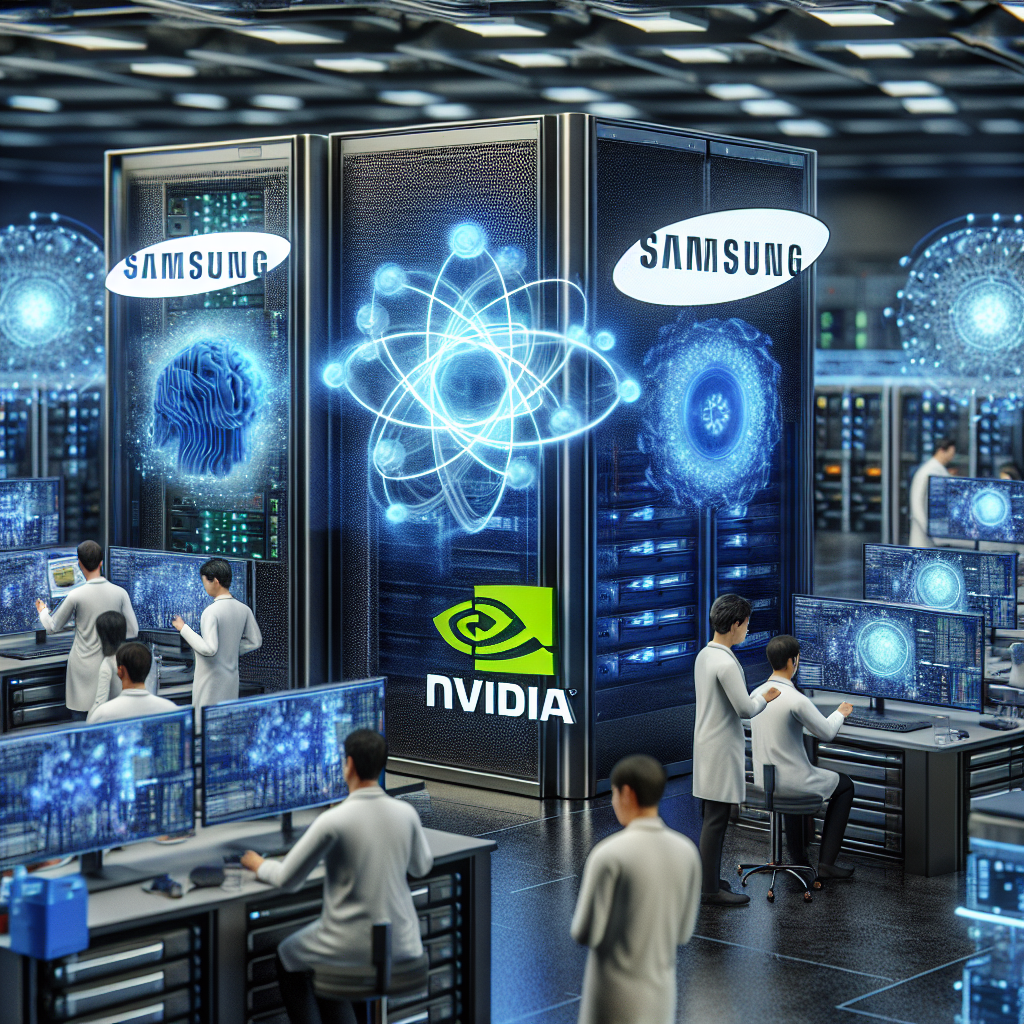
In an era where connectivity demands are skyrocketing, Samsung Electronics has made significant strides in integrating artificial intelligence with software-driven networks. The company recently announced the successful completion of a multi-cell test at its R&D center, demonstrating the powerful collaboration between its virtualized RAN (vRAN) software and NVIDIA’s cutting-edge accelerated computing platform. This achievement marks a pivotal moment in the journey toward fully commercial deployment of AI-enhanced networking solutions.
The forthcoming Mobile World Congress (MWC) 2026 will showcase this significant milestone, as Samsung plans to feature an AI-RAN demonstration running on NVIDIA’s AI infrastructure. This demonstration will highlight a novel AI-based downlink performance enhancement, known as the AI MIMO beamformer, which employs advanced AI algorithms to optimize throughput. It is designed to showcase how AI can vastly improve spectral efficiency, which ultimately benefits network operators by enabling them to extract greater capacity from their existing spectrum. This development exemplifies Samsung’s commitment to driving AI-RAN innovation toward commercialization.
Key stakeholders within Samsung underscore how AI-powered capabilities are becoming essential for addressing the diverse demands of evolving network landscapes. As Keunchul Hwang, Executive Vice President and Head of Technology Strategy Group, Networks Business at Samsung Electronics, stated, “Samsung’s vRAN takes center stage with its software-based architecture.” The successful execution of the multi-cell test with NVIDIA is a testament to Samsung’s leadership and determination in delivering enhanced flexibility and performance for operators, supported by a robust ecosystem that includes industry-leading CPU and GPU partnerships.
Additionally, Samsung and NVIDIA are not just resting on their laurels. They are actively collaborating to foster innovations that facilitate high-speed connections between CPU and GPU. This initiative leverages Samsung’s advanced vRAN alongside NVIDIA’s unified processor, which integrates both CPU and GPU within a single chipset. This synergy allows for rapid and efficient data exchanges, leading to an optimal balance between performance enhancement and cost-efficiency.
Last month, both companies took another significant step toward commercialization. They successfully integrated Samsung’s vRAN software with NVIDIA’s ARC Compact, which is equipped with the NVIDIA Grace CPU and NVIDIA L4 GPU. This integration spells exciting possibilities for Samsung, as the company is committed to exploring and validating the combined advantages this technology can offer to advanced networking solutions.
As Soma Velayutham, Vice President of AI and Telecoms at NVIDIA, noted, “Operators today need AI-native, software-defined infrastructure to stay ahead of evolving connectivity demands.” Samsung’s recent multi-cell validation, paired with their innovative AI beamforming solution running on NVIDIA AI Aerial, constitutes a crucial milestone on the road to AI-RAN commercialization.
The implications of Samsung’s advancements in AI-native software-defined networks are profound. By merging their extensive experience with large-scale commercial vRAN deployments and leveraging expertise from NVIDIA’s advanced computing platforms, Samsung is poised to maintain its leadership role in the burgeoning sector of AI-powered networks.
Furthermore, Samsung Networks has established itself as a pioneer in the delivery of end-to-end 5G solutions. This includes everything from chipsets and radio technologies to core networks. Their commitment to ongoing research and development underpins their aspiration to remain at the forefront of the telecom industry while addressing the pressing demands for speed, reliability, and efficiency in communication networks. As the digital world becomes ever more interconnected, Samsung’s innovations pave the way for a new era of AI-enhanced, software-driven communication infrastructures.
Leave a Reply