

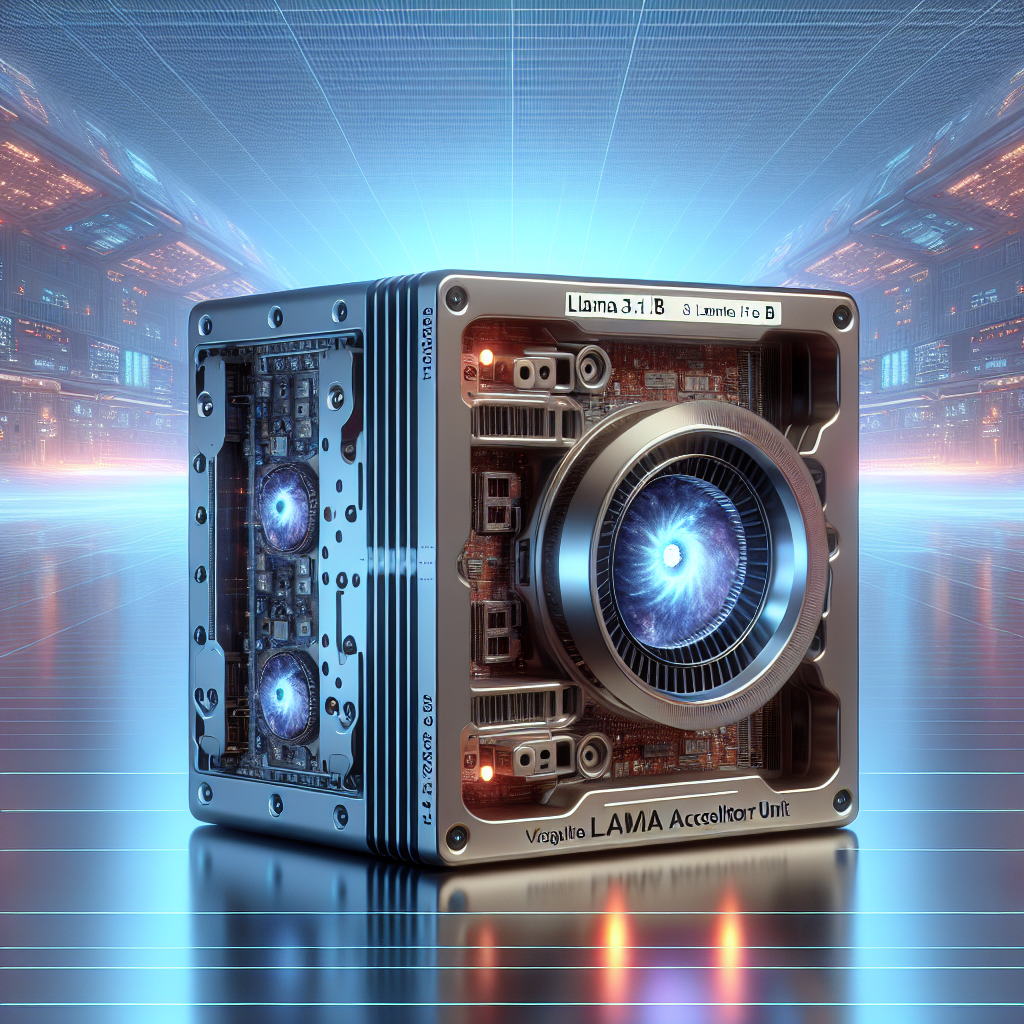
The Taalas HC1 AI accelerator is making waves in the technology landscape due to its remarkable performance metrics and impressive operational efficiencies. This hardware implementation is specifically designed to accelerate the Llama-3.1 8B AI model, achieving an unprecedented throughput of up to 17,000 tokens per second. Compared to conventional data center accelerators, such as NVIDIA’s B200 or Cerebras chips, the Taalas HC1 emerges as a game-changer, delivering significant advantages in speed, cost, and energy consumption.
What sets the Taalas HC1 apart is its exceptional speed; it is reportedly around 10 times faster than the Cerebras chip while being 20 times less expensive to manufacture. Moreover, the Taalas HC1 operates with a power requirement that is approximately 10 times lower than its competitors. The major trade-off for such impressive capabilities is the current limitation of the unit to the Llama-3.1 8B model. However, it is engineered to maintain a degree of flexibility. It supports a configurable context window size and utilizes low-rank adapters, known as LoRAs, for potential fine-tuning.
The architecture of the Taalas HC1 consolidates memory and compute on a single chip, addressing a common bottleneck found in Large Language Model (LLM) applications. Traditional designs often separate memory and compute capabilities, which operate at varying speeds, ultimately resulting in reduced efficiency. By integrating storage and compute functions at DRAM-level density, the Taalas HC1 chips are able to provide ultra-fast inference times. This makes them particularly well-suited for environments where multiple users need to access AI accelerators simultaneously or applications involving voice interaction with robots.
Upon reviewing a live demonstration of the Taalas HC1 through an online chatbot, I experienced firsthand its impressive performance. Queries such as “What is 2+2?” achieved a lightning-fast processing speed of 19,997 tokens per second. Even more complex inquiries, like “What do you know about CNX Software?” returned results at a respectable rate of around 15K to 16K tokens per second. However, it’s worth noting that while the output may be rapid, the accuracy can vary, especially for complex topics, as evident when I asked it to generate an extensive outline for a 100-page book. The AI was able to provide a structured outline of a potential 14-chapter book in just 0.064 seconds, highlighting its capability to process and organize information quickly.
Looking ahead, the company behind Taalas HC1 is already working on a second mid-sized reasoning LLM that will further exploit the silicon architecture of the HC1. This next iteration is expected to launch in Q2, followed by a more advanced second-generation silicon platform, dubbed HC2, set to facilitate even higher densities and faster performance. Deployments for this upgraded platform are anticipated by the end of the year, which promises to expand the capabilities of AI applications further and foster enhancements across various sectors.
The remarkable advancements represented by the Taalas HC1 AI accelerator serve to illustrate the continuously evolving landscape of AI technology and the pivotal role hardware innovation plays in this space. As we venture further into 2024, the need for fast, efficient, and affordable AI processing solutions becomes increasingly paramount for businesses across diverse industries. The success of the Taalas HC1 may open new doors for AI deployment in settings previously constrained by resource limitations.
Leave a Reply